

© Copyright 2026 Hiwire. All Rights Reserved
- Privacy Policy
- Cookie Policy
From digital to reality.
We design, 3D print, and build monumental art installations for commercial spaces. From concept to reality, we bring bold visions to life at scale.
Shaping Ideas Into Reality
How We Build Bold Ideas
From first sketch to final installation, every project follows a seamless creative journey. We merge design, technology, and craftsmanship to bring bold visions to life.
01
Design & Development
We start with your idea , translating it into detailed 3D models and visual concepts. This phase defines form, scale, and artistic intent.
02
Fabrication & Finishing
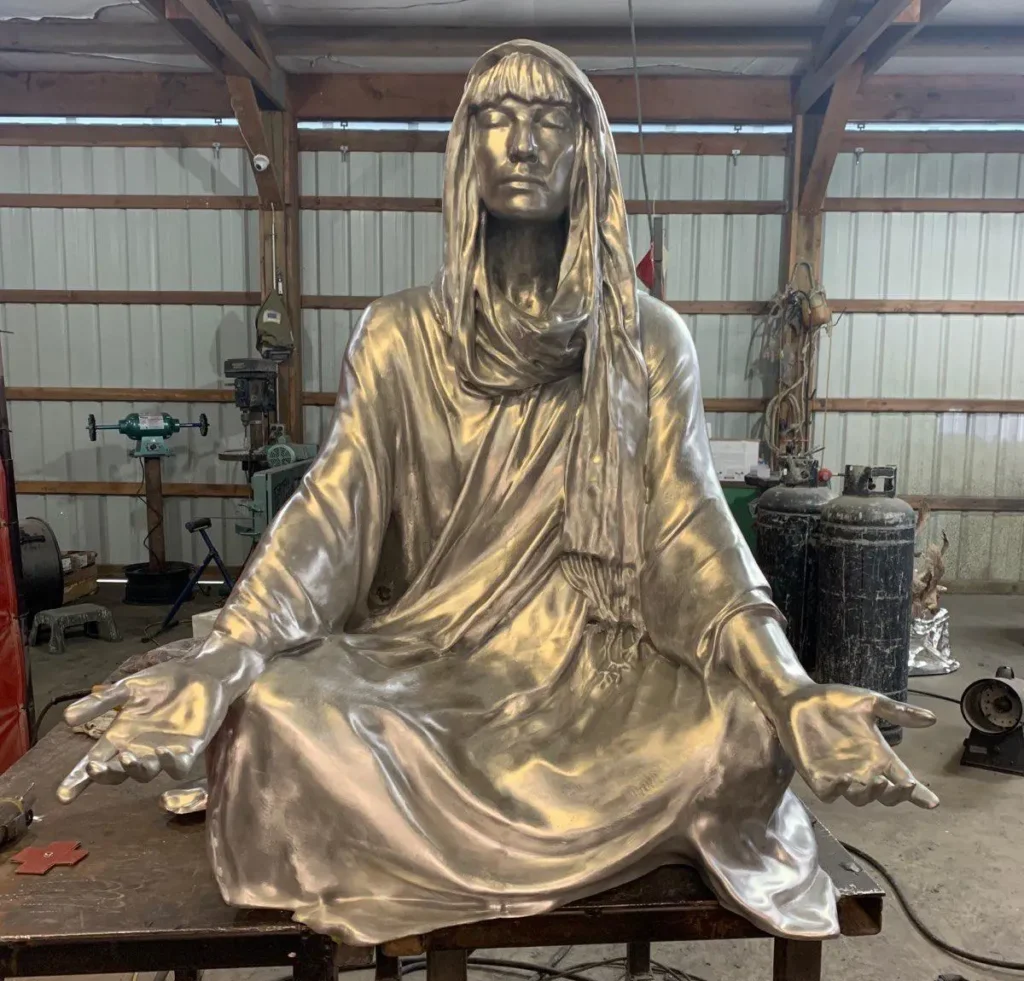
Our team transforms the digital design into reality using 3D printing, sculpting, and material finishing. Every detail is crafted with precision and care.
03
Installation & Delivery
We manage on-site assembly and installation, ensuring the artwork integrates perfectly into its environment , ready to inspire and captivate.

© Copyright 2026 Hiwire. All Rights Reserved
What Our Clients Say
We take pride in bringing bold ideas to life. Here’s what our clients and collaborators have to say about working with us—highlighting creativity, craftsmanship, and seamless execution.
Lorem ipsum dolor sit amet, consectetur adipiscing elit. Sed do eiusmod tempor incididunt ut labore et dolore magna aliqua.Ut enim ad minim veniam, quis nostrud exercitation ullamco laboris nisi ut aliquip ex ea commodo consequat.
Lorem ipsum dolor sit amet, consectetur adipiscing elit. Sed do eiusmod tempor incididunt ut labore et dolore magna aliqua.Ut enim ad minim veniam, quis nostrud exercitation ullamco laboris nisi ut aliquip ex ea commodo consequat.
Lorem ipsum dolor sit amet, consectetur adipiscing elit. Sed do eiusmod tempor incididunt ut labore et dolore magna aliqua.Ut enim ad minim veniam, quis nostrud exercitation ullamco laboris nisi ut aliquip ex ea commodo consequat.
Lorem ipsum dolor sit amet, consectetur adipiscing elit. Sed do eiusmod tempor incididunt ut labore et dolore magna aliqua.Ut enim ad minim veniam, quis nostrud exercitation ullamco laboris nisi ut aliquip ex ea commodo consequat.
Lorem ipsum dolor sit amet, consectetur adipiscing elit. Sed do eiusmod tempor incididunt ut labore et dolore magna aliqua.Ut enim ad minim veniam, quis nostrud exercitation ullamco laboris nisi ut aliquip ex ea commodo consequat.
Story Behind LA Hands
Location: 6th Street Bridge — Arts District & Boyle Heights, Los Angeles, USA
In 2023, the City of Los Angeles Department of Cultural Affairs approved the installation of two identical bronze sculptures by artist Glenn Kaino at either end of the new 6th Street Bridge, which opened in July 2022. Each sculpture, standing approximately 14 feet tall, depicts two hands forming an interlocking “LA” gesture, a symbol popularized by Estevan Oriol’s iconic 1995 photograph “L.A. Fingers.” The sculptures are positioned in future park spaces: one at the Arts District side and one at the Boyle Heights side of the bridge.
LOS ANGELES — On September 13, the City of Los Angeles Department of Cultural Affairs (DCA) granted official approval for the installation of two identical bronze sculptures by Glenn Kaino on either end of the new 6th Street bridge, which opened in July 2022. Each 14-foot sculpture will depict two hands with their fingers forming an interlocking “LA,” a symbol popularized by Estevan Oriol’s 1995 photograph “L.A. Fingers,” in which a Latina woman’s hands form the gesture. The sculptures will be located in yet-to-be-constructed parks located at the Western end of the bridge in the Arts District and in the Eastern end in Boyle Heights.
Kaino first received the commission in 2013, proposing a single sculpture as a symbol of connection between communities on both sides of the LA river. An early conception of the project involved one hand from each side of the river, composites made from casts of the hands of hundreds of residents.
Kaino himself has links to both sides of the river, with family roots on the East side and artistic roots on the West. “For many generations my family has lived a few miles from the bridge and I have a long personal history with it,” he told Hyperallergic. In 1997, he co-founded the artist-run space Deep River on Traction Avenue in the Arts District.
Although Kaino had originally wanted the sculpture located on the East side, a suitable site could not be found, so it was initially planned for the Arts District park, according to a 2019 LA Curbed article. When this was announced at a public meeting in 2019, it was met with frustration from Boyle Heights community members. Speakers expressed disappointment that the single sculpture would be located in the Arts District, despite it being more symbolically linked to the predominantly Latinx communities of the East Side. “They were very insistent that there needs to be equity on both sides,” Kaino says. “I was in full support of that.”
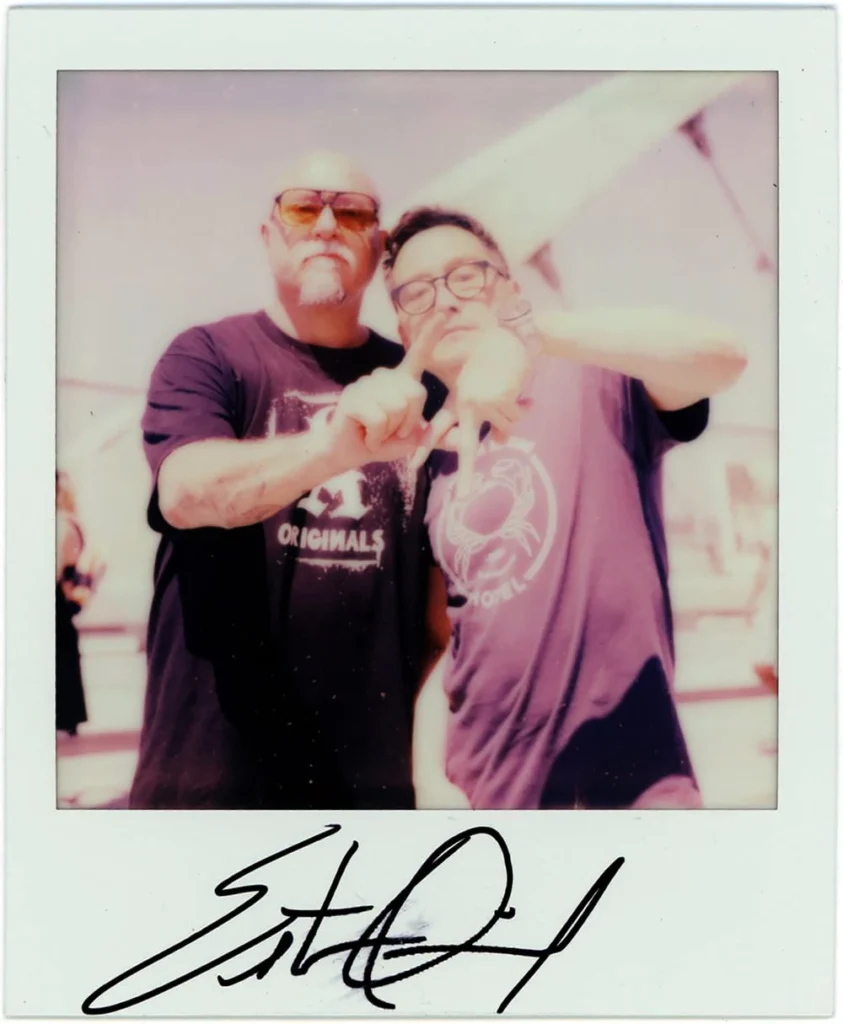
After the public outcry, the DCA made the decision to revise the project to feature two identical sculptures on each side of the bridge, according to a DCA representative. The budget for the project is $1.86 million, covered by the city’s Percent for Public Art program, which requires private developers to set aside one percent of their project’s valuation for public art.
Kaino had also received some criticism for not acknowledging Oriol’s photo as the source of his sculpture. Although Oriol did not create the hand gesture, his iconic 1995 photo is widely credited as having made it famous. The photographer has been documenting elements of lowrider, “Cholo,” hip-hop, graffiti, and tattoo cultures for the past three decades.
Kaino denies that he was trying to erase Oriol’s involvement with the image. “Obviously Estevan Oriol made that image famous,” he said at an October 2021 DCA meeting. “He’s a very important artist. He’s an icon, a veteran.”
At the meeting, Commissioner Evonne Gallardo asked about the legality of using the gesture. Oriol did in fact sue H&M and Brandy Melville in 2013 for producing shirts with an image of a similar hand gesture, but lost the case, as a judge ruled the images had significant differences.
Regardless of legality, Kaino said he would not move forward without Oriol’s approval. Fortunately, he was able to connect with the photographer shortly after the meeting, and the pair had several talks at Kaino’s studio. “We evolved the sculptures to be my hand and his hand,” Kaino says, “someone from the East side of the river, and someone from the West,” as Oriol was born in Santa Monica. (Oriol did not respond to Hyperallergic’s requests for comment.)
In addition to his participation in the sculpture itself, there will now be a plaque installed next to the sculptures attributing them to “Glenn Kaino featuring Estevan Oriol,” acknowledging his “L.A. Hands” photograph for popularizing the gesture, and commemorating his collaboration with Kaino. The plaque states that Oriol’s “artworks have transcended the locality of their creation to become universal symbols of pride, courage and humanity and a vital part of the Los Angeles landscape.”
Source: Hyperallergic
Story Behind the Artwork
Nike Groove, Lebron James
The installation explores the intersection of performance, identity, and visibility, positioning the athlete within a constructed environment of observation and display. By suspending the figure within a rigid structural frame and surrounding it with recording devices, the work reflects the conditions of constant exposure that define contemporary athletic stardom.
The figure of LeBron James becomes both performer and artifact — a subject shaped by motion, yet fixed within a system of representation. The surrounding retail elements anchor the installation within the commercial context, reinforcing the relationship between personal identity, product, and global brand culture.
Visual & Structural Development
The installation captures a dynamic athletic moment through 3D scanning and fabrication, balancing motion with structural precision. Lighting and spatial composition create a controlled environment where movement and stillness coexist.
Story Behind the Artwork
The Google Foxes project draws inspiration from the agility and cleverness of foxes, translating these qualities into clean, geometric forms with a bold, simplified color palette. Each figure was carefully designed to balance abstraction with recognizable animal characteristics, emphasizing dynamic posture and movement.
The creative process combined digital 3D modeling, prototyping, and hand-finishing techniques. Precision painting and surface treatments were applied to achieve consistent, vibrant finishes that enhance the sculptures’ expressive forms. Through these methods, the project bridges digital design tools and traditional fabrication practices.
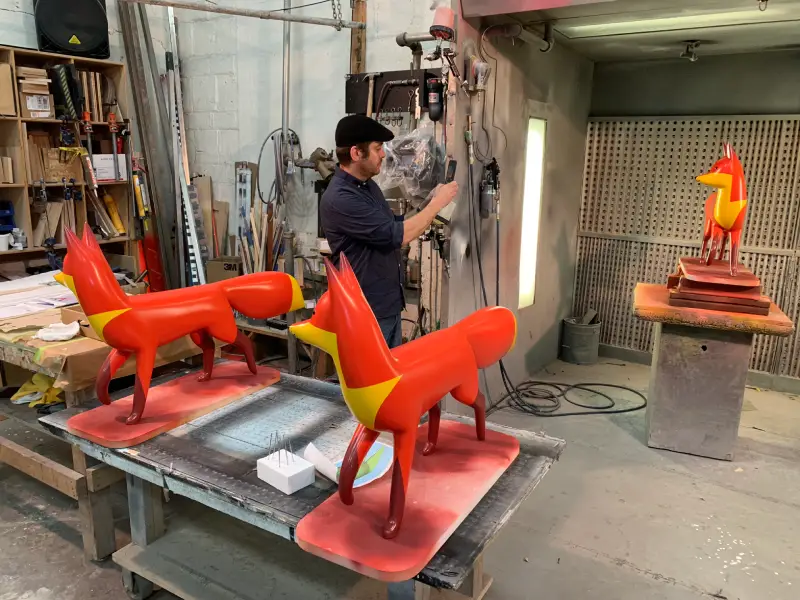
The project also highlights interaction and narrative. By presenting foxes as approachable yet dynamic figures, the installation encourages viewers to engage visually and conceptually, creating a memorable and playful spatial experience.
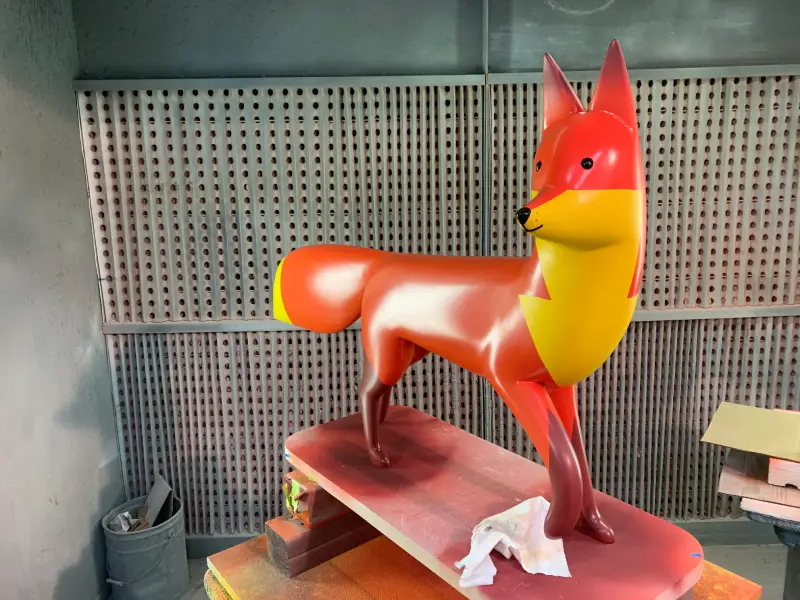
Project Overview
Google Foxes is a vibrant sculptural installation featuring stylized fox figures created with precision fabrication techniques. The project merges digital design, color theory, and physical modeling to produce visually striking, playful figures that embody agility, curiosity, and energy. These sculptures transform the space into an interactive and visually engaging environment, showcasing how bold, minimal forms can communicate character and motion while reflecting Google’s design-forward identity.
Project Overview
The Inuit Dome Manholes project is a creative reinterpretation of traditional Inuit architectural forms applied in an urban context. By using the iconic dome silhouette, the project transforms everyday infrastructure—manholes—into sculptural, culturally inspired urban elements. The design blends heritage motifs with contemporary street art techniques, creating visually engaging interventions within public spaces.
This project highlights how cultural narratives can be embedded in functional urban objects, transforming mundane city elements into points of curiosity and reflection.
Story Behind the Artwork
The design of Inuit Dome Manholes draws inspiration from the geometry and symbolism of traditional igloos. The project emphasizes modularity, visual storytelling, and contextual responsiveness, turning ordinary manhole covers into a playful nod to cultural heritage.
The process involved conceptual sketching, stencil creation, and meticulous site application. The artwork was carefully designed to work with existing urban infrastructure while retaining the essence of Inuit forms. This fusion of culture and modern urban elements creates a dialogue between tradition and contemporary city life.
The project also fosters community engagement by encouraging viewers to consider the hidden narratives embedded in urban spaces, highlighting how art can reimagine the everday.
Through stenciling and urban surface application, the project transforms ordinary manholes into culturally inspired visual statements. Each dome motif was crafted to respect the scale, placement, and texture of its location, ensuring both aesthetic impact and urban integration. The resulting installation bridges art, design, and public space, inviting passersby to engage with their surroundings in a new and meaningful way.
Project Overview
Location: Chicago, Illinois, USA
Nike React Chicago is a dynamic installation created to celebrate the launch of Nike’s React technology. The project transforms a retail or exhibition environment into an energetic visual experience that reflects the innovation, performance, and bold identity of the Nike brand.
Through sculptural design, vibrant colors, and spatial graphics, the installation highlights the responsive nature of Nike React cushioning while creating an engaging environment for visitors and sneaker enthusiasts.
Story Behind the Artwork
The concept behind Nike React Chicago focuses on translating the feeling of motion and energy into a physical installation. Inspired by the lightweight and responsive characteristics of Nike React technology, the design uses bold forms, graphic elements, and immersive spatial arrangements to create a visually striking environment.
The installation aims to capture the spirit of movement and innovation that defines Nike’s performance footwear while engaging audiences through a memorable brand experience.
The development of the installation involved digital design, spatial planning, and fabrication techniques to bring the concept to life. Designers explored different materials, structural elements, and lighting solutions to emphasize the energetic character of the React product line.
Careful attention was given to scale, color, and composition so the final installation would stand out within the urban environment of Chicago while maintaining a strong connection to Nike’s design language.
Project Overview
The Nike Fiberglass Kettle Bell is a sculptural reinterpretation of a classic fitness tool, exploring the intersection of industrial design, material experimentation, and brand identity. Crafted from translucent fiberglass, the piece emphasizes both form and texture while incorporating the iconic Nike swoosh as a subtle design element.
This project demonstrates how everyday objects can be transformed into visually striking, high-concept design pieces. By combining familiar functional shapes with unconventional materials, the kettle bell challenges perceptions of utility and aesthetics in the context of sport and lifestyle objects.
Story Behind the Artwork
The Nike Fiberglass Kettle Bell explores material innovation, durability, and branding in physical form. The design process emphasized experimentation with fiberglass casting techniques, surface textures, and transparency to create an object that is simultaneously recognizable, functional, and visually intriguing.
The piece merges industrial fabrication methods with sculptural sensibilities, resulting in a kettle bell that highlights material qualities such as translucence, texture, and weight perception. The subtle branding reinforces the connection between design, performance, and aesthetic appeal, making it both a functional object and an artistic statement.
Project Overview
Location: London, United Kingdom
Nike’s Women Figures in Ceramics is a dynamic installation that brings together art, fashion, and retail design through sculptural forms. The project features a series of ceramic figures representing women in motion, each embodying energy, confidence, and athletic grace. These figures explore the intersection of movement, materiality, and the human form, creating a visually compelling environment within the retail space. The project highlights how ceramic art can engage audiences in a commercial context while maintaining conceptual and aesthetic depth.
Story Behind the Artwork
The Women Figures Ceramics project draws inspiration from everyday athletic movement, street culture, and Nike’s ethos of empowerment and performance. Each figure captures a specific posture, gesture, or action, celebrating women’s presence in both sport and urban life.
The creative process involved extensive study of human motion, sculpting prototypes, and experimenting with ceramic materials to achieve texture, color, and form that resonate with Nike’s brand identity. The sculptures were carefully fabricated, fired, and finished to balance durability with a tactile, lifelike quality.
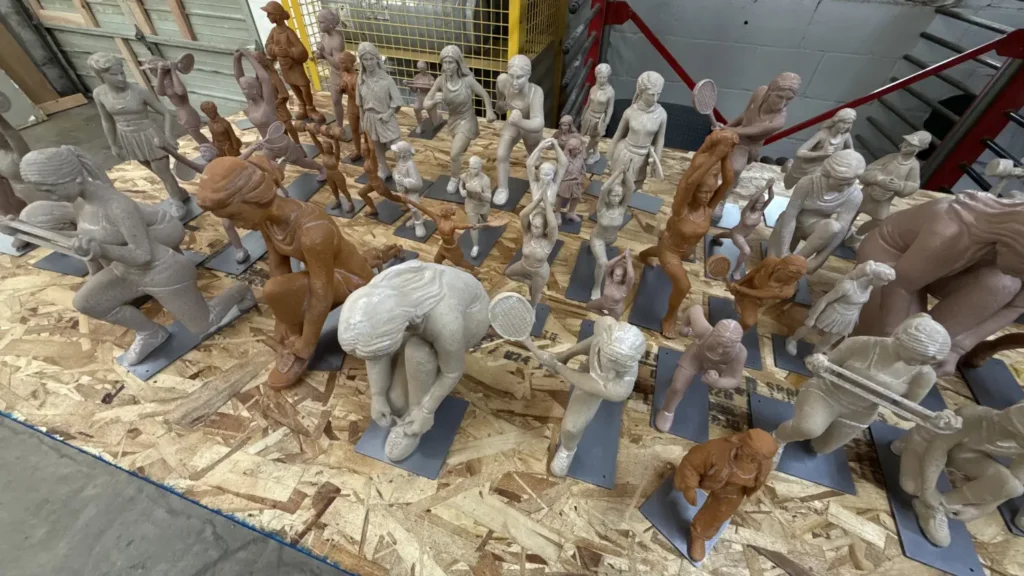
Beyond the physical craft, the project emphasizes narrative and representation. By portraying women in dynamic poses, the installation reflects themes of strength, agility, and individuality. It transforms the retail environment into a space of artistic expression, inviting viewers to interact with both the figures and the broader brand experience.
Project Overview
Stations of the Cross is a contemplative sculptural installation that reinterprets a spiritual narrative through contemporary design and fabrication. The work transforms traditional storytelling into an immersive spatial experience, inviting viewers to engage with the journey in a physical way.
Through a series of crafted forms, the installation creates a rhythm of movement and reflection, guiding visitors through moments of pause and connection. The project merges art, architecture, and symbolism to create a meaningful experience that resonates across cultures.
Story Behind the Artwork
The installation draws inspiration from the traditional Stations of the Cross, a sequence representing moments from a historic spiritual journey. Each station is reimagined as a sculptural form, translating narrative into abstract shapes that evoke emotion, movement, and meaning without relying on literal representation.
By combining traditional craftsmanship with advanced digital modeling and fabrication techniques, the project bridges past and present. The forms are designed to communicate a universal story of endurance, reflection, and transformation, allowing viewers to interpret the work through their own perspectives.
The development process explored how spatial arrangement, scale, and materiality could enhance the emotional impact of the installation. Each element was carefully considered to create a cohesive experience—one that unfolds progressively as visitors move through the sequence.
Digital tools and fabrication methods played a key role in refining the forms and ensuring precision, while preserving the expressive quality of the original concept. The final installation stands as a dialogue between tradition and innovation, where symbolic meaning is translated into a contemporary sculptural language.
Story Behind the Artwork
The artwork features a series of vessels and spacecraft-like forms arranged in an upward spiral, suspended in the air as if traveling toward the sky. These imagined crafts draw inspiration from different cultures, eras, and visions of space exploration.
For the creation of the installation, Kaino collaborated with origami master Robert J. Lang and young participants from South Los Angeles. Children were invited to draw their own imaginative spacecraft designs, which were then transformed into complex three-dimensional origami sculptures. These shapes were digitally scanned and integrated into the final sculptural structure.
The piece references the idea of humanity’s shared curiosity about the universe and our collective dreams of exploration. By combining traditional craft, digital technology, and public participation, the installation reflects a collaborative vision of the future.
The development of Distance of the Sun involved a creative process that merged art, engineering, and digital design. Early concepts explored how spacecraft forms could be arranged in a spiral composition that appears to rise toward the skylight above the station.
The sculptures were developed using digital modeling techniques and detailed structural planning to ensure they could be safely suspended in the large architectural space. The final installation creates the impression of a floating journey toward the sky, symbolizing movement, imagination, and the human desire to explore beyond our world.
Visual Concept & Digital Development
This video shows the digital modeling and visual development process behind the artwork. The animation reveals how the sculptural forms evolve from skeletal structures into fully realized shapes, demonstrating the transformation from conceptual design to physical installation.
This project by Sherin Guirguis explores the intersection of cultural narratives, craft, and material experimentation. Through layered patterns, bold textures, and intricate forms, the work transforms the space into a visually compelling environment that celebrates both tradition and contemporary artistic practice.
The installation engages viewers in an immersive experience, encouraging reflection on identity, community, and the expressive potential of materials in modern art.
Story Behind the Artwork
Guirguis’ work emphasizes the dialogue between historical craft techniques and contemporary design. By combining textures, colors, and sculptural forms, the installation evokes cultural memory while creating a vibrant, modern aesthetic.
The creative process involved careful planning of patterns, layers, and spatial composition to ensure that each element interacted harmoniously with the environment. The final installation highlights the interplay between structure, color, and perception, drawing viewers into an engaging, contemplative experience.
Visual & Experiential Development
This video showcases the installation’s design and execution. It captures how the layered patterns and sculptural elements transform the space, emphasizing Sherin Guirguis’ unique approach to material, color, and cultural storytelling.
Project Overview
Clipper – Inuit Dome is an innovative installation that merges traditional Inuit architectural concepts with contemporary design and fabrication techniques. The dome structure explores the relationship between space, environment, and community, creating a functional and visually striking architectural form.
The project demonstrates how heritage, materiality, and engineering can be combined to create structures that are both culturally significant and technically sophisticated.
Story Behind the Artwork
The Inuit Dome draws inspiration from traditional igloo forms while incorporating modern materials and fabrication methods. The design emphasizes modular construction, sustainability, and responsiveness to environmental conditions.
The creative process involved planning the geometric structure, testing modular components, and carefully sequencing assembly to achieve both durability and aesthetic harmony. By integrating cultural heritage with contemporary design, the dome becomes an expressive architectural and artistic statement, inviting viewers to engage with space in a new and meaningful way.
In addition to its structural and aesthetic qualities, the project emphasizes community and educational engagement. Workshops and collaborative sessions with local participants informed the design process, allowing cultural knowledge and practical insights to shape the final installation. This collaborative approach not only honors traditional practices but also fosters a deeper connection between the artwork, its environment, and the people who experience it.
Visual & Structural Development
This video documents the design, fabrication, and assembly of the Inuit Dome. It illustrates the transformation from conceptual design to a fully realized structure, highlighting the precision, material innovation, and cultural inspiration behind the project.
Story Behind the Artwork
The helmet series expands Glenn Kaino’s exploration of identity, memory, and inherited experience, shifting inward from his broader practice of collaboration and socially engaged work. Rooted in his Japanese American heritage, the works reflect a personal investigation into history, protection, and resilience.
The samurai helmet, or kabuto, serves as a symbolic reference point — a form historically associated with honor, defense, and the warrior identity. Rather than focusing on historical replication, the work reinterprets this cultural form through a contemporary sculptural language, bridging personal narrative with collective symbolism.
The development of the series combined digital modeling, sculptural refinement, and fabrication planning to translate this traditional form into a contemporary object. Careful attention to proportion, surface language, and structural clarity allowed the helmet’s silhouette to remain recognizable while being reimagined through modern material approaches.
The final works emphasize precision and restraint, highlighting how historical forms can be recontextualized as contemporary sculptural expressions that carry both personal and cultural meaning.
Location: AlUla, Saudi Arabia
NAJMA (She Placed One Thousand Suns Over the Transparent Overlays of Space) is a large-scale desert installation by artist Lita Albuquerque created for Desert X AlUla 2020 in AlUla, Saudi Arabia. The artwork forms a constellation-like pattern across the desert landscape, connecting the physical environment with the celestial sky above.
The installation reflects Albuquerque’s long exploration of deserts as places of reflection, knowledge, and cosmic connection. By mapping a field of stars onto the land, the project invites viewers to consider humanity’s relationship with astronomy, myth, and the vastness of the universe.
Story Behind the Artwork
The project is part of Albuquerque’s ongoing artistic narrative involving a mythic figure named Elyseria—an astral traveler who represents human curiosity and the search for knowledge. Through this story, the artist connects ancient traditions of stargazing with contemporary artistic expression.
In NAJMA, the installation recreates a star field corresponding to the sky above AlUla at the moment the exhibition opened. Visitors are invited to walk through the constellation-like arrangement, experiencing a symbolic map that links the earth, the stars, and the shared history of human exploration and scientific discovery.
The development of NAJMA involved careful planning to align the artwork with the actual position of stars in the sky over AlUla. The installation was placed on a desert boulder within a secluded valley and positioned to correspond precisely with celestial coordinates at the opening of the exhibition on January 31, 2020.
By combining site-specific design, astronomical references, and sculptural elements, the artwork transforms the desert landscape into a contemplative space where visitors can experience the connection between culture, nature, and the cosmos.
NAJMA Installation
This video showcases NAJMA in the desert landscape of AlUla, highlighting how the installation interacts with the surrounding environment and the night sky. The work transforms the desert into a symbolic constellation, connecting the land with the stars above.
Nike Futura 2000 is a striking installation and design collaboration that combines the futuristic aesthetic of Nike with the creative vision of Futura 2000. The project blends large-scale sculpture, digital design, and meticulous craftsmanship to create an eye-catching display that reflects Nike’s innovative brand identity.
For a deeper look at the project, visit the original feature on ICNCLST.
Story Behind the Artwork
The Futura 2000 project draws inspiration from both street art and industrial design, translating the iconic style of the artist into a large-scale physical installation. The creative process included designing conceptual forms, 3D modeling, and collaborating closely with fabrication teams to bring the digital concepts into reality.
The final installation demonstrates a balance between artistic vision and technical precision, emphasizing scale, materiality, and interaction with the surrounding space. By integrating cutting-edge fabrication techniques with Futura 2000’s signature aesthetics, the project creates a visually compelling and memorable experience for viewers.
Design & Installation
This video showcases the installation of Nike Futura 2000, highlighting the final design, scale, and spatial impact of the project. It demonstrates the fusion of artistic vision and technical execution, bringing the concept to life in a visually striking display.